3D Shapes for Kids: Names, Faces, Edges and Corners
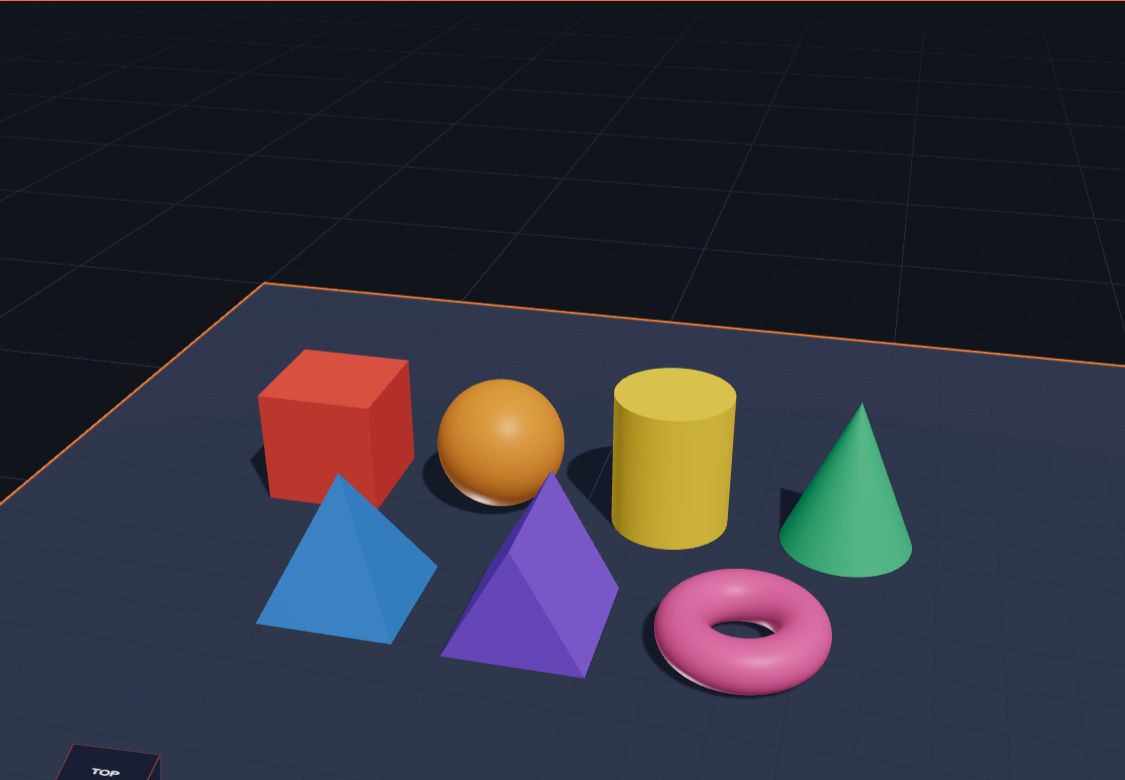
A 3D shape is a shape you can hold. It has width, depth and height, so it takes up space. A ball, a box and a can of beans are all 3D shapes. A drawing of a circle on paper is flat, so it's a 2D shape.
In this lesson you will learn the names of the most important 3D shapes, how to count their faces, edges and corners, and where you can spot them in real life. Then you can build every one of them in Kids 3D Lab.
Three words to know
- Face: a flat or curved surface. On a dice, each side with dots is a face.
- Edge: where two faces meet. Run your finger along the side of a box and you are following an edge.
- Corner: where edges meet in a point. Maths books often call a corner a vertex. More than one are vertices.
The 3D shapes
Cube
A cube is a box where every side is the same size. It has 6 faces, all squares. It has 12 edges and 8 corners. You can find cubes in dice, sugar cubes and building blocks.
Cuboid
A cuboid is a box shape where the faces are rectangles. It has 6 faces, 12 edges and 8 corners, just like a cube, but it can be long, flat or tall. Cereal boxes, bricks and books are cuboids. In Kids 3D Lab, the Box shape makes both cubes and cuboids.
Sphere
A sphere is a perfectly round ball. It has 1 curved face, no edges and no corners. Every point on it is the same distance from the middle. Footballs, marbles and oranges are spheres (or very close!). In Kids 3D Lab it's called Ball.
Cylinder
A cylinder has two flat circles, one at each end, joined by a curved side. It has 2 flat faces and 1 curved face, 2 curved edges and no corners. Cans, candles and toilet roll tubes are cylinders.
Cone
A cone has a flat circle at the bottom and comes up to a point. It has 1 flat face and 1 curved face, 1 curved edge and 1 corner at the tip. Ice cream cones, party hats and traffic cones are cones.
Pyramid
A square pyramid has a square at the bottom and four triangles that meet at the top. It has 5 faces, 8 edges and 5 corners. The famous pyramids in Egypt are square pyramids. In Kids 3D Lab, you can change the Sides of a Pyramid to make a triangle pyramid, or one with six sides.
Triangular prism
A triangular prism has two triangles at the ends, joined by three rectangles. It has 5 faces, 9 edges and 6 corners. A tent and a slice of cheese often look like this. In Kids 3D Lab, use the Triangle shape and turn it on its side. The Ramp is a triangular prism too!
Torus
A torus is a donut shape: a ring with a hole in the middle. It has 1 curved face, no edges and no corners. Rings, rubber rings and bagels are tori. In Kids 3D Lab it's called Donut.
The shapes at a glance
| Shape | Faces | Edges | Corners | Real thing |
|---|---|---|---|---|
| Cube | 6 | 12 | 8 | Dice |
| Cuboid | 6 | 12 | 8 | Cereal box |
| Sphere | 1 | 0 | 0 | Football |
| Cylinder | 3 | 2 | 0 | Can |
| Cone | 2 | 1 | 1 | Ice cream cone |
| Square pyramid | 5 | 8 | 5 | Pyramids in Egypt |
| Triangular prism | 5 | 9 | 6 | Tent |
| Torus | 1 | 0 | 0 | Donut |
Try it in Kids 3D Lab
The best way to learn shapes is to hold them, or to build them!
- Open Kids 3D Lab and click New build.
- Click Box, Ball, Cylinder, Cone, Pyramid and Donut in the Shapes list. Each one lands in an empty spot on the plate.
- For the prism, click Triangle. Under Turn, set X to 90 so it lies on its side, like a tent.
- Hold the right mouse button and drag to look at each shape from every side. Count the faces, edges and corners. Do they match the table?
Shape challenges
- Cube or cuboid? Pick the box. Make it 20 wide, 20 deep and 20 tall. That's a cube. Now make it 40 wide. What is it now?
- Change a cylinder. A cylinder has a Smoothness number. Set it to 6. Now it has six flat sides: a hexagonal prism! Set it to 3. What shape do you get?
- Cut a sphere in half. Pick the ball and push its Z to minus half its diameter. The bottom half goes under the plate and is hidden. Now you have a dome, which is half a sphere: a hemisphere.
- Build with shapes. Most real things are made of simple shapes. A snowman is three spheres. A rocket is a cylinder and a cone. What can you build from your seven shapes?
Questions kids ask
Is a circle a 3D shape?
No. A circle is flat, so it's a 2D shape. A sphere is the 3D version of a circle. In the same way, a square is 2D and a cube is 3D.
What's the difference between a cube and a square?
A square is flat: it only has width and height. A cube has width, height and depth. A cube is made of six squares stuck together.
How many faces does a cylinder have?
Two flat faces (the circles at each end) and one curved face. Some people say 3 faces, and some only count the 2 flat ones.
Which 3D shape has the most faces?
Shapes can have as many faces as you like! A football is made of 32 pieces. In Kids 3D Lab, try a Gem or a Pyramid with 12 sides.
For grown-ups
Recognising and describing 3D shapes is part of early maths in most school systems, usually from around age 5 to 9. Building the shapes on screen adds something a worksheet can't: children can spin a shape, look at it from any side, and count its faces themselves. Change one number, like the sides of a pyramid, and they see how the shape and its properties change together. If you have a 3D printer, printing a set of small shapes gives children something real to hold and sort. See What Is CAD? for how designers use these same basic shapes, and Millimetres Made Easy to practise measuring them.
Keep reading
 Maths & science
What Is CAD? Explained for Kids
CAD means computer-aided design. Learn what CAD is, who uses it, how it helps make cars, phones and toys, and how you can start doing CAD today.
5 min read
Maths & science
What Is CAD? Explained for Kids
CAD means computer-aided design. Learn what CAD is, who uses it, how it helps make cars, phones and toys, and how you can start doing CAD today.
5 min read
 App skills
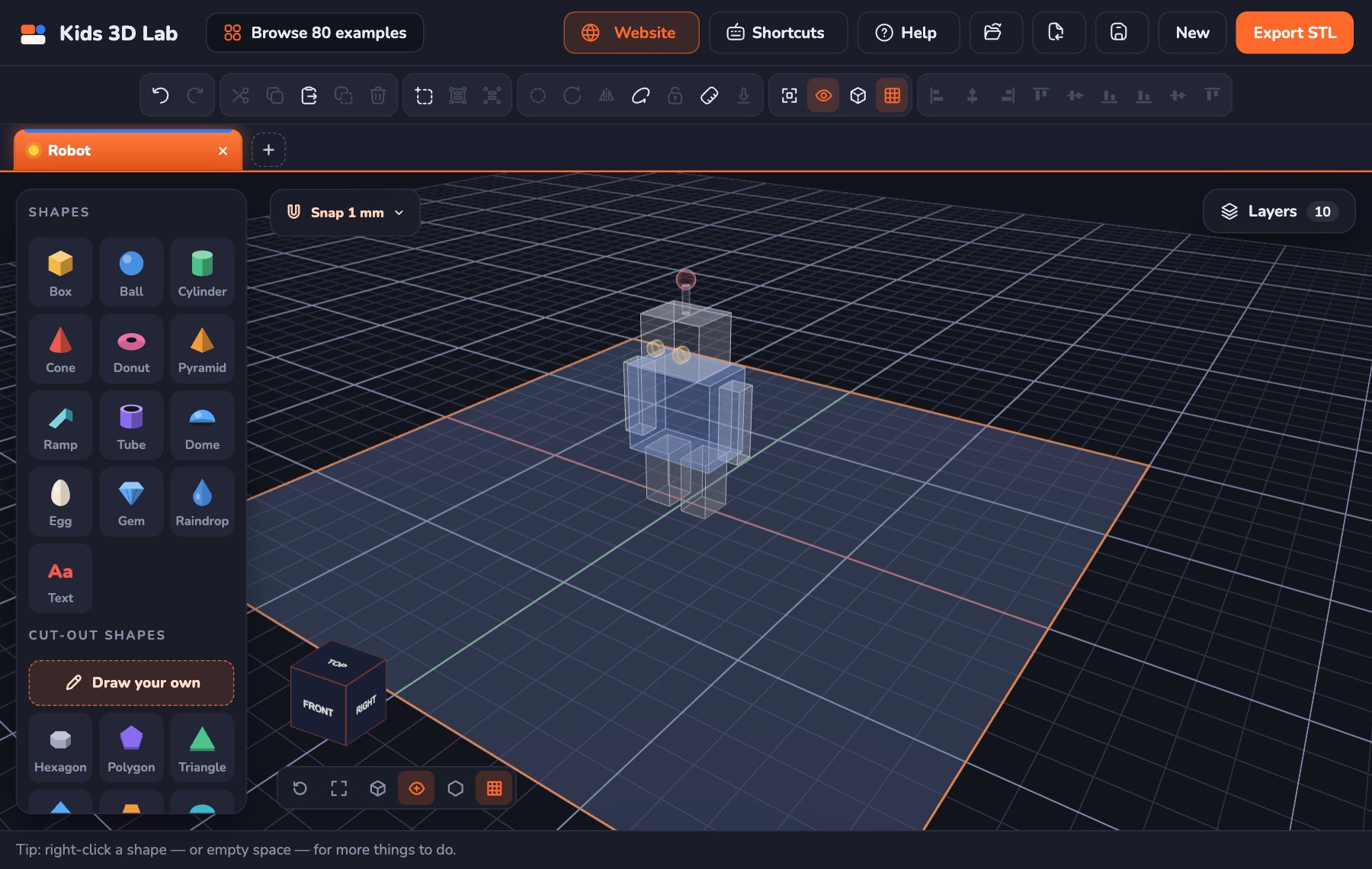
See Inside Your Build: X-ray, Outline, Layers and Flat Views
New in Kids 3D Lab — flat Top, Front and Side views like real CAD, X-ray and Outline to see inside your build, a Layers list to pick any shape, and a right-click menu.
5 min read
App skills
See Inside Your Build: X-ray, Outline, Layers and Flat Views
New in Kids 3D Lab — flat Top, Front and Side views like real CAD, X-ray and Outline to see inside your build, a Layers list to pick any shape, and a right-click menu.
5 min read
 3D printing
What Is 3D Printing?
A 3D printer makes real things you can hold, one thin layer at a time. Here is how it works, in simple words.
5 min read
3D printing
What Is 3D Printing?
A 3D printer makes real things you can hold, one thin layer at a time. Here is how it works, in simple words.
5 min read