What Is Symmetry? Make Models That Match
Symmetry means that one part of a shape matches another part exactly. Fold a picture of a butterfly down the middle, and the two wings land right on top of each other. That's symmetry!
Symmetry is everywhere: in faces, flowers, snowflakes, buildings, cars and toys. Designers use it all the time, because symmetrical things look balanced and often work better. In this lesson you will learn the two main kinds of symmetry, and build some symmetrical models in Kids 3D Lab.
Kind 1: Mirror symmetry
A shape has mirror symmetry (also called line symmetry or reflection symmetry) if you can draw a line through it, and one side is a mirror picture of the other. The line is called the line of symmetry.
Examples:
- A butterfly has one line of symmetry, right down its body.
- A heart has one line of symmetry, from the top dip to the bottom point.
- A square has four lines of symmetry: up, across and the two diagonals.
- The letter A has one line of symmetry, up the middle. The letter H has two!
Kind 2: Turning symmetry
A shape has turning symmetry (also called rotational symmetry) if you can turn it part of the way round, and it looks exactly the same as before.
Examples:
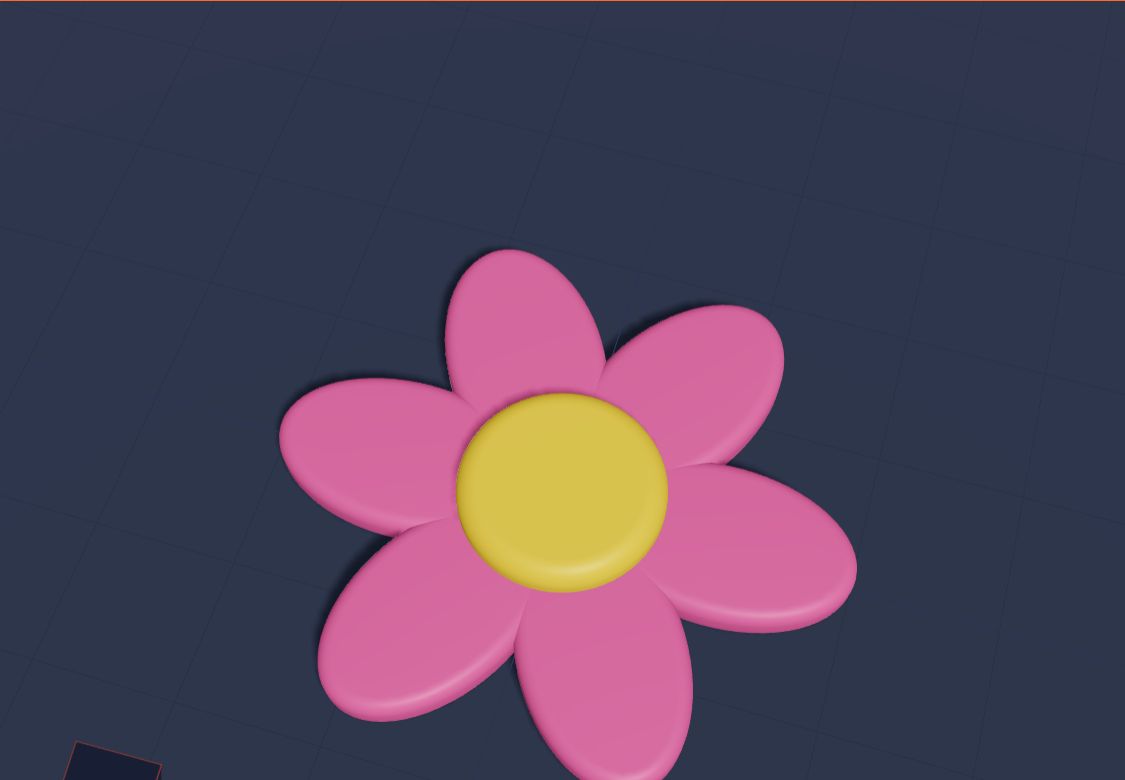
- A flower with six petals looks the same after a sixth of a turn.
- A starfish with five arms looks the same after a fifth of a turn.
- A windmill or a fan has turning symmetry, but often no mirror symmetry, because its blades all lean the same way.
The number of ways a shape fits onto itself in one full turn is called its order. A six-petal flower has turning symmetry of order 6.
Symmetry in 3D
In 3D, mirror symmetry uses a flat mirror plane instead of a line. Imagine slicing a toy car down the middle, from front to back. The left half and the right half match. Cars, aeroplanes, chairs and people are all (nearly) symmetrical this way.
Things that are round all the way around, like a cup or a vase, have turning symmetry. You can turn them by any amount and they look the same.
Build it: a mirror-symmetry butterfly
Kids 3D Lab has a Flip tool that makes a mirror copy. Let's use it.
- Open Kids 3D Lab and click New build.
- Click Draw your own in the Shapes list. The drawing board opens.
- With the Pencil, draw one wing of a butterfly, on the right half of the board. Let go, and the ends join up.
- Set the Thickness to 3 and click Put it on the plate.
- Press Ctrl + D (on a Mac, ⌘ + D) to make a copy.
- Under Flip, click ⇆ X. The copy becomes a mirror picture!
- Drag the copy to the left until the two wings meet in the middle.
- Add a long thin Egg or Cylinder for the body, down the middle.
You made a symmetrical butterfly. The body is on the line of symmetry, and each wing is a mirror of the other.
Build it: a turning-symmetry flower
- Open the Flower example from the start page, or build your own:
- Click Oval. Set Width 11, Depth 18 and Height 3. This is one petal.
- Make six copies, and set their Turn Z to 0, 60, 120, 180, 240 and 300.
- Move each one so they make a ring around the middle.
- Add a Cylinder in the middle, diameter 14.
Why 60 degrees? A full turn is 360 degrees, and 360 ÷ 6 = 60. For a five-petal flower, use 360 ÷ 5 = 72.
Practice gameLine things upPick the shape that stays put, and line the others up with it.Play →Symmetry challenges
- Your initials. Which letters in your name have mirror symmetry? Make them with Text and check by turning the view.
- Half a face. Build half of a robot's face, copy it, flip it, and join the halves.
- A star. The Star shape has a Points number. How many lines of symmetry does a 5-point star have? (Answer: 5!)
- Break the symmetry. Take a symmetrical car and add one thing to just one side, like a door handle. It still looks balanced, but it isn't perfectly symmetrical any more.
Questions kids ask
Is a heart symmetrical?
Yes! A heart has one line of mirror symmetry, straight down the middle.
Are people symmetrical?
Almost! From the outside, your left side is very nearly a mirror of your right side. But not perfectly. Look closely in a mirror, and you may spot small differences.
Can something have both kinds of symmetry?
Yes. A square has four lines of mirror symmetry and turning symmetry of order 4. A circle has endless lines of symmetry and looks the same at any turn.
Why do designers like symmetry?
Symmetrical things look balanced and calm. They are also often stronger and steadier. A table with legs placed symmetrically doesn't wobble.
Is flipping a shape the same as symmetry?
They're close friends! Flipping shapes makes a mirror image, called a reflection. If a shape looks exactly the same after you flip it, it has symmetry. Try flipping shapes in Kids 3D Lab, and see Turn, Flip and Stretch for how.
For grown-ups
Symmetry appears in maths curricula from the early years, usually starting with line symmetry in 2D shapes and moving to rotational symmetry. Building in 3D adds a hands-on twist: the Flip tool performs a real reflection, and the turn angles make the link between rotational symmetry and division clear (360 ÷ number of parts). Ask your child to predict where a mirror copy will land before they click Flip. For more ways to turn and flip shapes, see Turn, Flip and Stretch. The Cookie Cutter project is another good, symmetrical make.
Keep reading
 Maths & science
What Is CAD? Computer-Aided Design Explained for Kids
What does CAD stand for? CAD means computer-aided design. Learn what CAD is, what 3D CAD and CAD in DT mean, who uses it, and how kids can start doing CAD today, for free.
6 min read
 Maths & science
3D Shapes for Kids: Names, Faces, Edges and Corners
Learn the names of 3D shapes — cube, sphere, cylinder, cone, pyramid, prism and more — with their faces, edges and corners, and real things that look like them.
6 min read
 App skills
See Inside Your Build: X-ray, Outline, Layers and Flat Views
New in Kids 3D Lab — flat Top, Front and Side views like real CAD, X-ray and Outline to see inside your build, a Layers list to pick any shape, and a right-click menu.
5 min read